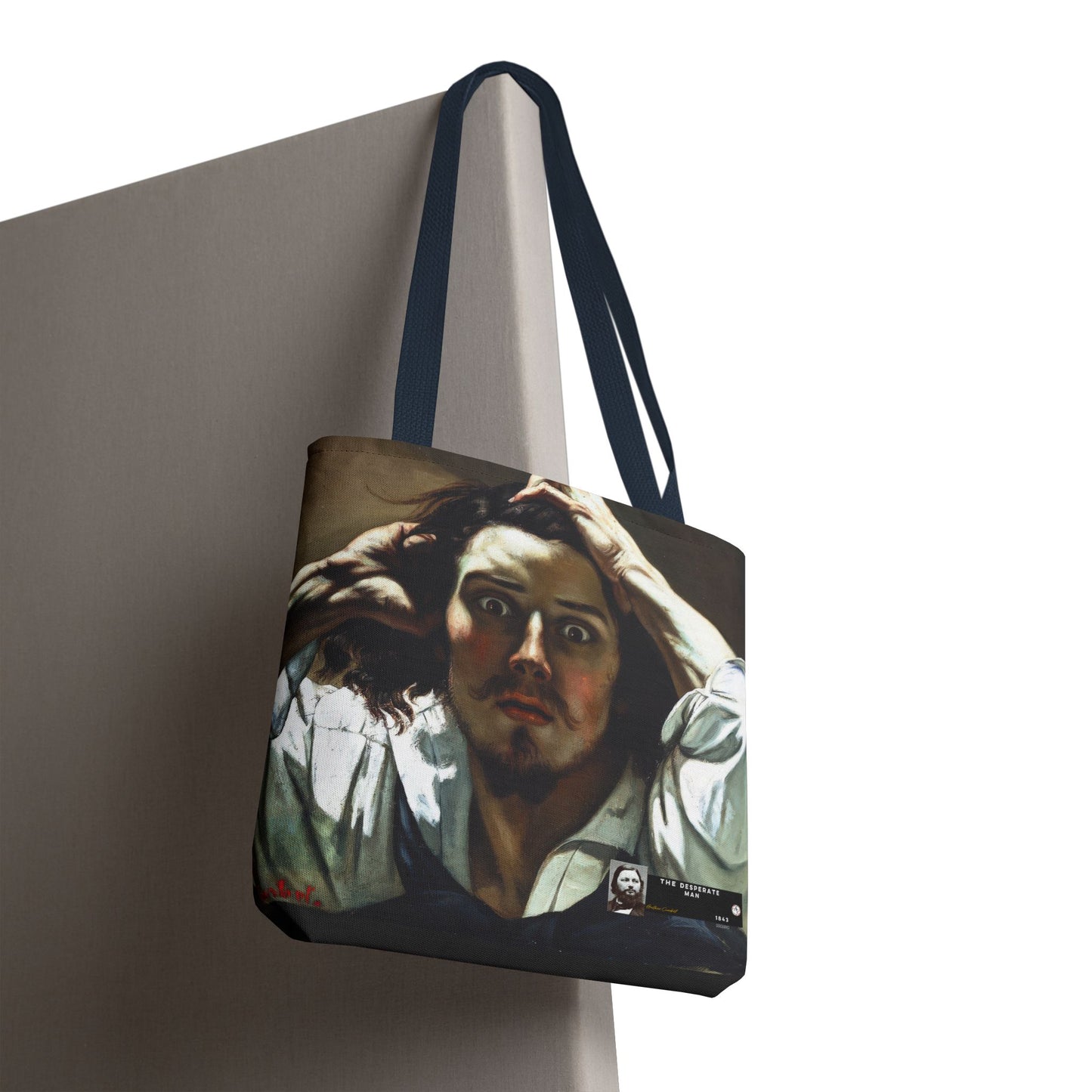
Courbet, Gustave - The Desperate Man (1843) - Tote Bag
Free shipping to Domestic US addresses!
Vendor
PrintifySub total
$30

Description
Description
The Bag That Goes Everywhere the Work Does
Spun polyester body, cotton webbing handles, nonwoven laminate lining — this tote is built for daily load-bearing, not occasional display. Dye sublimation printing wraps the entire surface, so the image reads the same whether the bag is full or empty. Double-stitched seams and boxed corners give it structure; the five handle color options let the design lead. Available in three sizes. Size tolerance ±¾ inch.
Care Instructions
Empty the bag completely before cleaning. Pretreat any visible stains, then wipe down with warm water, laundry detergent, and a soft cloth or brush. Air dry only — do not machine wash or put in the dryer.
Art Story
Art Story
The Portrait of a Breaking Point
Gustave Courbet did not paint this for the public. He painted it for himself. In 1843, Paris was a suffocating grid of coal smoke and bourgeois gatekeepers. The young artist was struggling against a system that demanded polished, polite perfection. Instead, Courbet delivered raw, wide-eyed panic. He kept this canvas in his studio until the day he died. It was his favorite child because it was his most honest moment.
The lighting is a direct theft from the Old Masters. He used the deep shadows of Rembrandt and the sharp, violent highlights of Caravaggio to frame his own face. This is not a formal sitting. It is a snapshot of a man tearing at his hair while his world falls apart. By 1843, the daguerreotype was already starting to replace the soul of painting with mechanical accuracy. Courbet responded by leaning into the one thing a camera couldn't capture. He captured the internal scream.
This work sits on the razor edge between two eras. It has the emotional weight of Romanticism but the ugly, unwashed grit of the coming Realist movement. Courbet was tired of performing for an audience that did not care. He chose to look into a mirror and record the rejection and the revolutionary angst of the Latin Quarter. It remains one of the most relatable images in art history because everyone knows the feeling of being pushed too far.
Bibliography
Courbet, Gustave. Letters of Gustave Courbet. Edited by Petra ten-Doesschate Chu. University of Chicago Press, 1992.
Faunce, Sarah, and Linda Nochlin. Courbet Reconsidered. Brooklyn Museum, 1988.
Rubin, James H. Courbet. Phaidon Press, 1997.
Toussaint, Hélène. Gustave Courbet, 1819-1877. Grand Palais, 1977.
Shipping & Satisfaction
Free shipping on all US orders, always.
Every order ships to US addresses at no additional cost. Allow up to 10 business days from fulfillment for delivery.
Your investment is protected. Material or print defects are replaced or fully refunded — no friction, no negotiation. If the work doesn't resonate aesthetically within 5 days of receipt, reach out and we'll make it right.
One note worth reading before you order: because every piece is produced on demand, we're unable to accommodate returns for incorrect size selections. Consult the product specs before you commit — they're there to make sure what arrives is exactly what you envisioned.