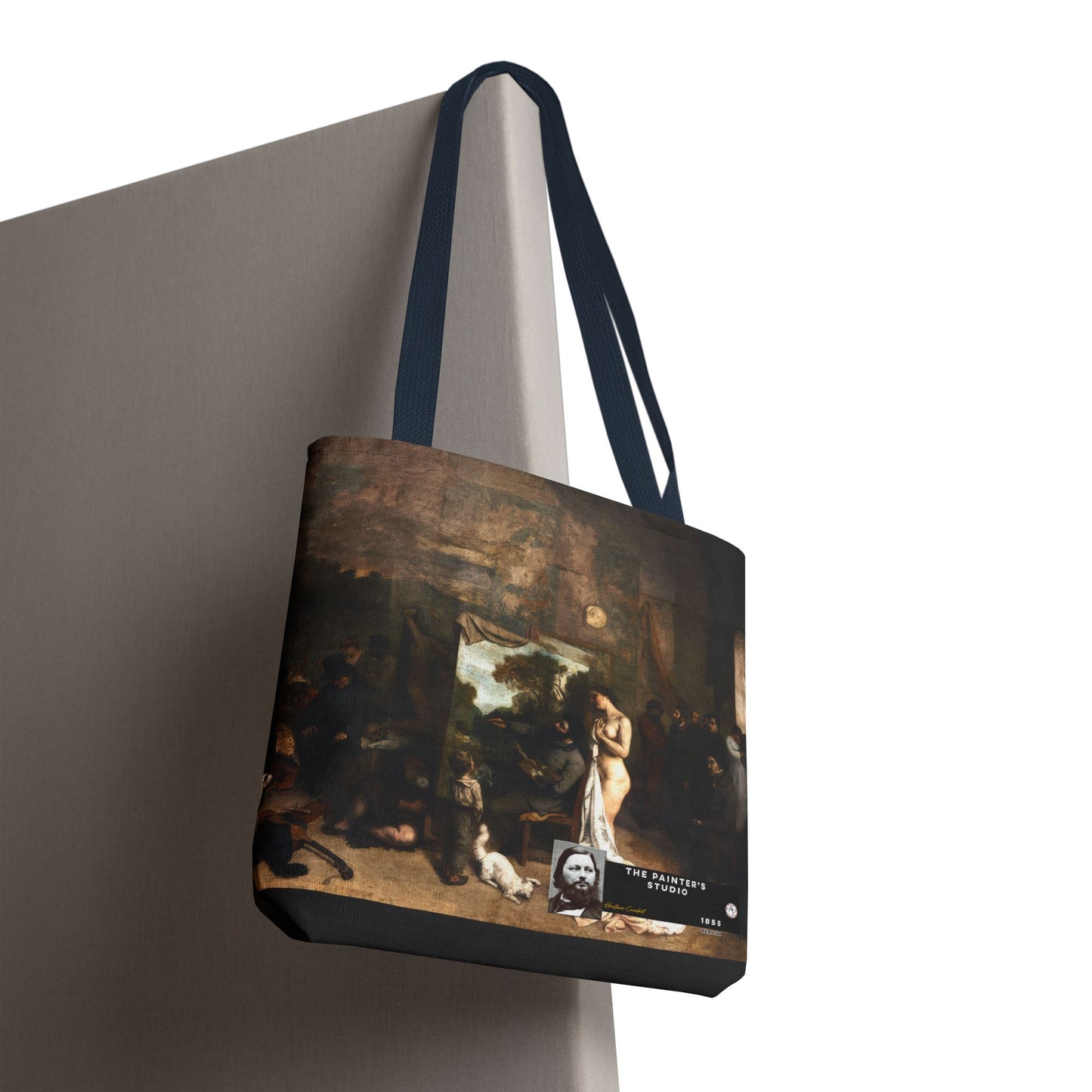
Courbet, Gustave - The Painter’s Studio (1855) - Tote Bag
Free shipping to Domestic US addresses!
Vendor
PrintifySub total
$30

Description
Description
The Bag That Goes Everywhere the Work Does
Spun polyester body, cotton webbing handles, nonwoven laminate lining — this tote is built for daily load-bearing, not occasional display. Dye sublimation printing wraps the entire surface, so the image reads the same whether the bag is full or empty. Double-stitched seams and boxed corners give it structure; the five handle color options let the design lead. Available in three sizes. Size tolerance ±¾ inch.
Care Instructions
Empty the bag completely before cleaning. Pretreat any visible stains, then wipe down with warm water, laundry detergent, and a soft cloth or brush. Air dry only — do not machine wash or put in the dryer.
Art Story
Art Story
The Pavilion of Spite
Gustave Courbet didn’t just paint a picture in 1855. He built a bunker.
When the jury for the Exposition Universelle rejected his massive canvas, Courbet did not go home to sulk. He erected his own building right next to their official gala and called it the Pavilion of Realism. It was a middle finger made of brick and mortar.
The Painter’s Studio is a nearly 20-foot wide record of a man who refused to blink. At the center, Courbet sits at his easel, flanked by a nude model who represents the unvarnished truth. He painted her from a photograph, not a live model or a classical ideal. Using a photo for reference was the ultimate dirty shortcut for a 19th-century artist.
To his right sit the supporters. The poets, the critics, and the soul-searchers who fueled his fire. To his left are the enemies and the exploited — priests, merchants, and the poor who represented the rot of the old world. It is a visual manifesto of a man who claimed he could not paint an angel because he had never seen one.
Courbet dragged art out of the clouds and shoved its face into the mud of the French countryside. He was a disruptor who understood that if the Academy refused him a seat at the table, he would simply build a better table.
References
Clark, T.J. Image of the People: Gustave Courbet and the 1848 Revolution. University of California Press, 1999.
Courbet, Gustave. Letters of Gustave Courbet. Edited by Petra ten-Doesschate Chu. University of Chicago Press, 1992.
Faunce, Sarah. Courbet. Abrams Publishers, 1988.
Nochlin, Linda. Realism. Penguin Books, 1971.
Shipping & Satisfaction
Free shipping on all US orders, always.
Every order ships to US addresses at no additional cost. Allow up to 10 business days from fulfillment for delivery.
Your investment is protected. Material or print defects are replaced or fully refunded — no friction, no negotiation. If the work doesn't resonate aesthetically within 5 days of receipt, reach out and we'll make it right.
One note worth reading before you order: because every piece is produced on demand, we're unable to accommodate returns for incorrect size selections. Consult the product specs before you commit — they're there to make sure what arrives is exactly what you envisioned.