Skip to product information
1 of 106

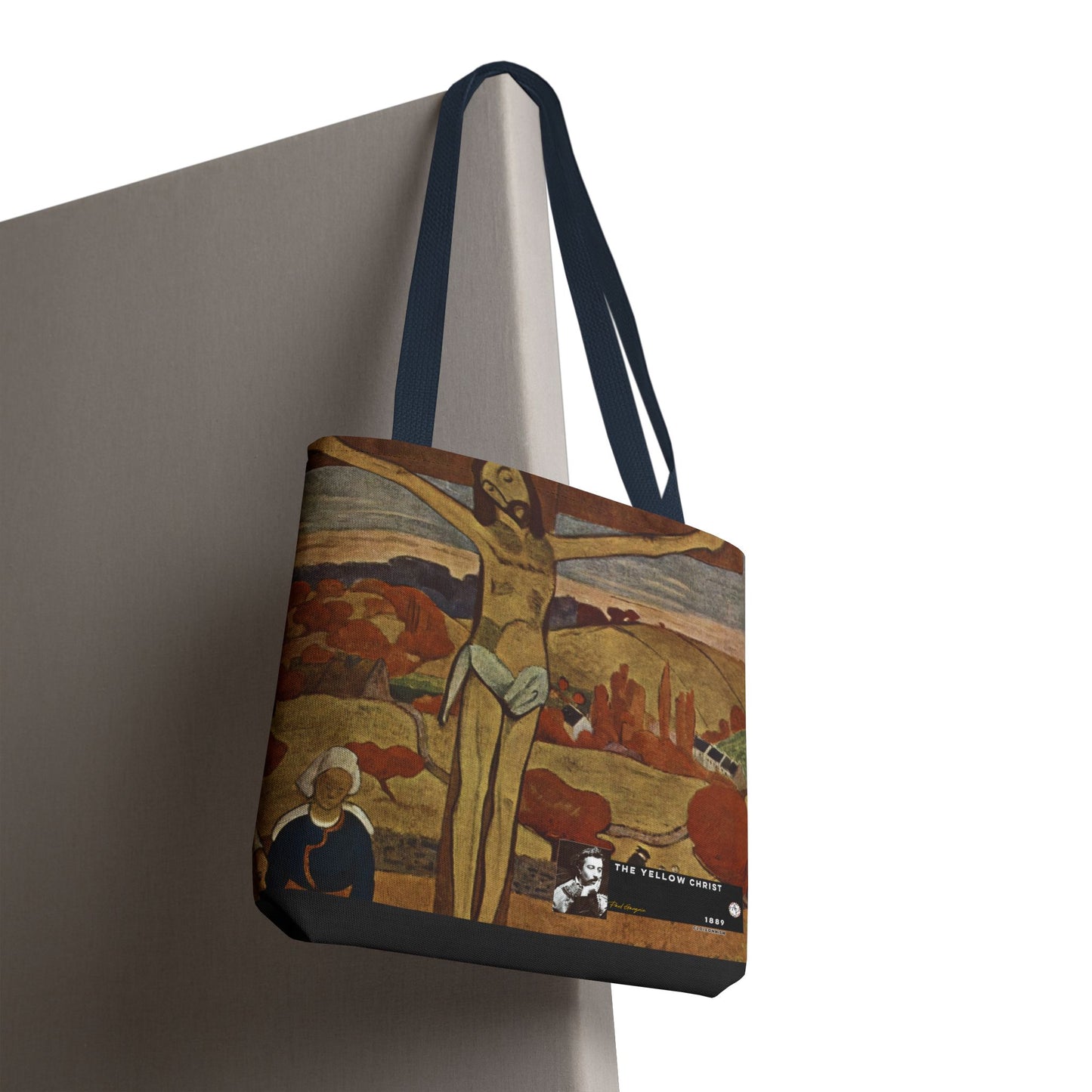
Gauguin, Paul - The Yellow Christ (1889) - Tote Bag

Gauguin, Paul - The Yellow Christ (1889) - Tote Bag

Regular price $30
Sale price $30 Regular price
OFF Sold out
Shipping calculated at checkout.

Free shipping to Domestic US addresses!

Vendor

Printify

Sub total

$30
  • American Express
  • Apple Pay
  • Diners Club
  • Discover
  • Google Pay
  • Mastercard
  • PayPal
  • Shop Pay
  • Venmo
  • Visa
View full details
Description

The Bag That Goes Everywhere the Work Does

Spun polyester body, cotton webbing handles, nonwoven laminate lining — this tote is built for daily load-bearing, not occasional display. Dye sublimation printing wraps the entire surface, so the image reads the same whether the bag is full or empty. Double-stitched seams and boxed corners give it structure; the five handle color options let the design lead. Available in three sizes. Size tolerance ±¾ inch.

Care Instructions

Empty the bag completely before cleaning. Pretreat any visible stains, then wipe down with warm water, laundry detergent, and a soft cloth or brush. Air dry only — do not machine wash or put in the dryer.

Art Story

Paul Gauguin didn't move to Brittany for the scenery. He went there because he was done with the light-dappled fluff of the Impressionists and the cold iron of the Eiffel Tower. In 1889, while Paris was worshiping electricity and steam at the Exposition Universelle, Gauguin was standing in the mud of Pont-Aven. He was looking for something ancient. He wanted a primitive soul that the modern world had already started to execute.

The Yellow Christ is not a portrait of a Sunday service. It is a manifesto of Cloisonnism. Gauguin rejected naturalism by drenching the world in a flat, unapologetic yellow. He didn't care if the grass looked like a real field. He wanted it to feel like the autumn transition between life and the coming winter. The Christ figure wasn't a vision from the clouds either. It was modeled after a 17th-century wooden crucifix he found in a local chapel in Tremalo.

The heavy dark outlines around the figures mimic medieval stained glass and Japanese woodblock prints. It is a flattened, spiritual space where peasant women in traditional coifs pray to a wooden idol that has come to life in their own fields. While the rest of the world was staring at the raw power of the new century, Gauguin was obsessing over ancient superstitions and the smell of heavy wool soaked in rain. He saw the death of the sacred coming and he tried to trap it on a canvas before it vanished forever.

References

Gauguin, Paul. The Writings of a Savage. Edited by Daniel Guérin. New York: Viking Press, 1978.

Thomson, Belinda. Gauguin. London: Thames & Hudson, 1987.

Brettell, Richard. The Art of Paul Gauguin. Washington: National Gallery of Art, 1988.

Eisenman, Stephen. Gauguin's Skirt. London: Thames & Hudson, 1997.

Shipping & Satisfaction

Shipping & Satisfaction

Free shipping on all US orders, always.

Every order ships to US addresses at no additional cost. Allow up to 10 business days from fulfillment for delivery.

Your investment is protected. Material or print defects are replaced or fully refunded — no friction, no negotiation. If the work doesn't resonate aesthetically within 5 days of receipt, reach out and we'll make it right.

One note worth reading before you order: because every piece is produced on demand, we're unable to accommodate returns for incorrect size selections. Consult the product specs before you commit — they're there to make sure what arrives is exactly what you envisioned.

About your query!