Skip to product information
1 of 76

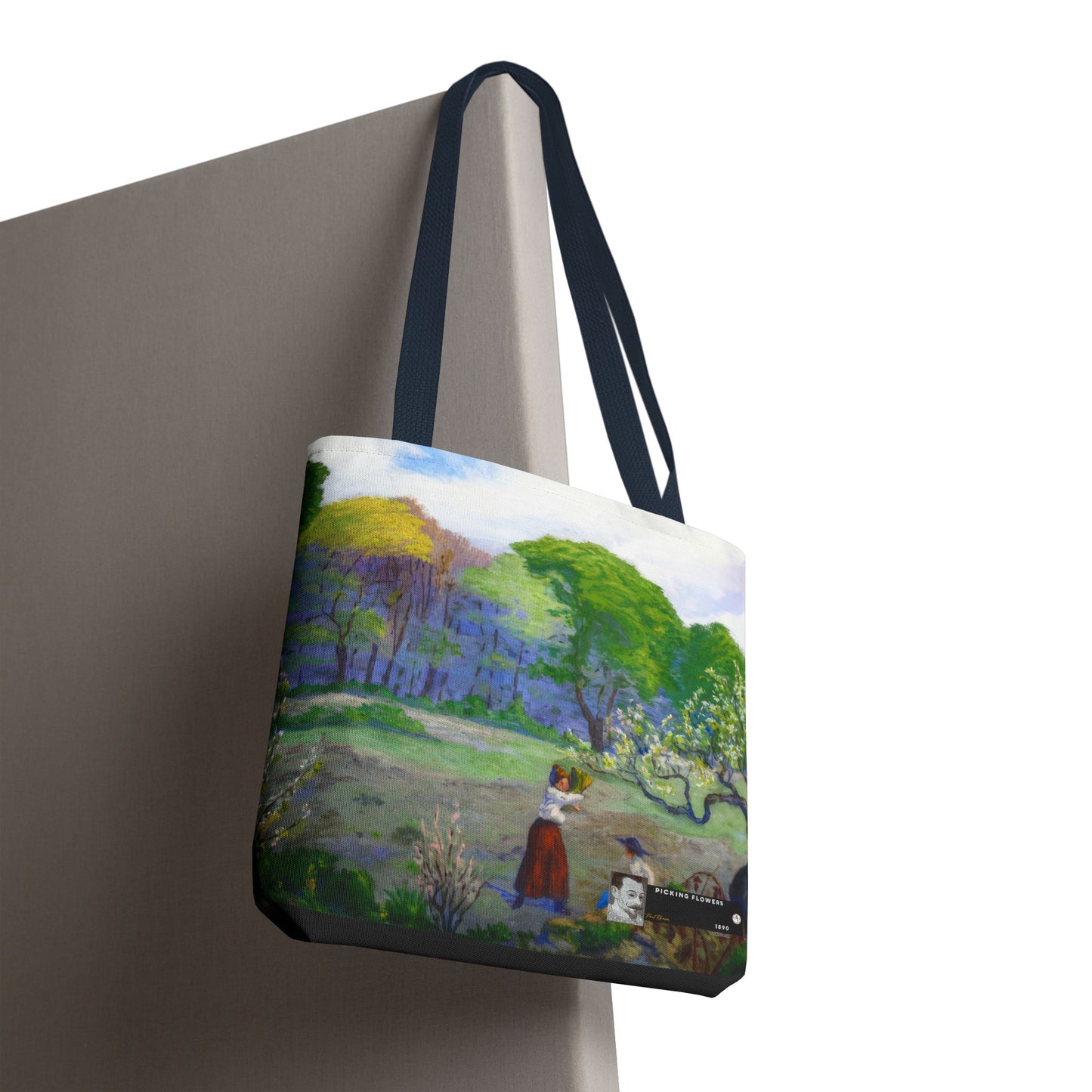
Ranson, Paul - Picking Flowers (1890) - Tote Bag

Ranson, Paul - Picking Flowers (1890) - Tote Bag

Regular price $30
Sale price $30 Regular price
OFF Sold out
Shipping calculated at checkout.

Free shipping to Domestic US addresses!

Vendor

Printify

Sub total

$30
  • American Express
  • Apple Pay
  • Diners Club
  • Discover
  • Google Pay
  • Mastercard
  • PayPal
  • Shop Pay
  • Venmo
  • Visa
View full details
Description

The Bag That Goes Everywhere the Work Does

Spun polyester body, cotton webbing handles, nonwoven laminate lining — this tote is built for daily load-bearing, not occasional display. Dye sublimation printing wraps the entire surface, so the image reads the same whether the bag is full or empty. Double-stitched seams and boxed corners give it structure; the five handle color options let the design lead. Available in three sizes. Size tolerance ±¾ inch.

Care Instructions

Empty the bag completely before cleaning. Pretreat any visible stains, then wipe down with warm water, laundry detergent, and a soft cloth or brush. Air dry only — do not machine wash or put in the dryer.

Art Story

Flat Truths and Floral Patterns

Paul Ranson painted Picking Flowers because he was bored with the way art tried to lie to people. In 1890 the French art world was still obsessed with depth and perspective. Ranson and his circle of friends had other ideas. They called themselves the Nabis and they met in the studio of Ranson which they called The Temple. They were looking for a new way to see the world that did not involve pretending a flat canvas was a window.

This work is the sound of a hammer hitting a mirror. Ranson looked at Japanese woodblock prints and saw the future. He stripped away the traditional modeling that made bodies look heavy. There are no shadows here to help you find your way around the figures. Everything is flat and decorative. The patterns of the dresses and the flowers bleed into each other until the whole thing feels like a tapestry or a high-end wallpaper.

He was bridging a gap that most people did not even know existed yet. He was taking fine art and pushing it toward modern design. He understood that a painting could be beautiful just by existing as a series of shapes and colors on a surface. It did not need to be a lecture on anatomy. Ranson died in 1909 but this piece remains a witness to the moment when art stopped trying to be a photograph and started trying to be a vibe.

References

Frèches-Thory, Claire and Antoine Terrasse. The Nabis: Bonnard, Vuillard, and Their Circle. New York: Harry N. Abrams, 1991.

Kostenevich, Albert. French Art from the Middle of the Nineteenth to the Early Twentieth Century in the Hermitage Museum. Florence: Bonechi, 2008.

Shipping & Satisfaction

Shipping & Satisfaction

Free shipping on all US orders, always.

Every order ships to US addresses at no additional cost. Allow up to 10 business days from fulfillment for delivery.

Your investment is protected. Material or print defects are replaced or fully refunded — no friction, no negotiation. If the work doesn't resonate aesthetically within 5 days of receipt, reach out and we'll make it right.

One note worth reading before you order: because every piece is produced on demand, we're unable to accommodate returns for incorrect size selections. Consult the product specs before you commit — they're there to make sure what arrives is exactly what you envisioned.

About your query!