Skip to product information
1 of 4

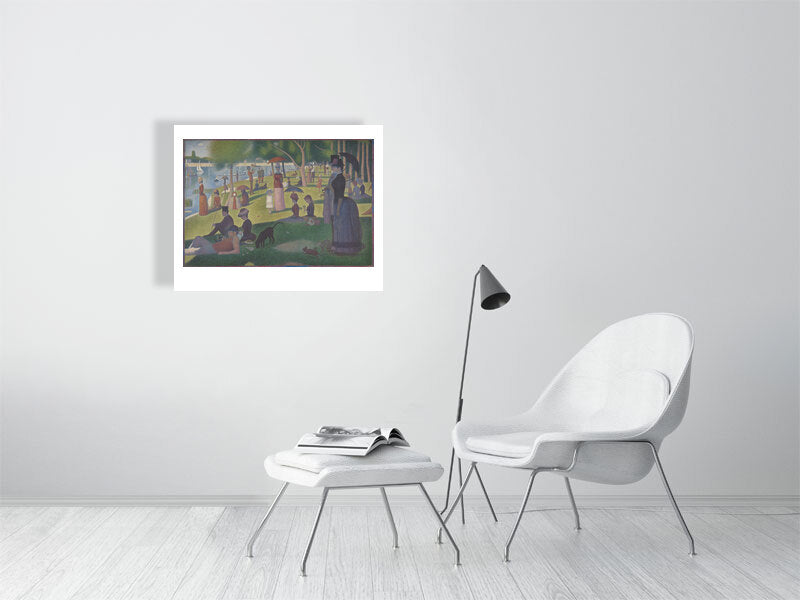
Seurat, Georges - A Sunday Afternoon on the Island of La Grande Jatte (1884)

Seurat, Georges - A Sunday Afternoon on the Island of La Grande Jatte (1884)

Regular price $210
Sale price $210 Regular price
OFF Sold out
Shipping calculated at checkout.

Free shipping to Domestic US addresses!

Vendor

AdamPacio.com

Sub total

$210
  • American Express
  • Apple Pay
  • Diners Club
  • Discover
  • Google Pay
  • Mastercard
  • PayPal
  • Shop Pay
  • Venmo
  • Visa
View full details
Description

Selecting a piece of history for your home is an act of curation that reflects your own journey toward clarity and center. This fine art giclée is more than a reproduction; it is a high-fidelity window into the Modern Art Canon, produced with the technical precision required for professional gallery display. By prioritizing archival materials and local Brooklyn craftsmanship, we ensure that the intellectual resonance of the artwork is matched by its physical presence in your space.

Every print is designed to provide a sense of lasting value and quiet confidence. This is an investment in your environment, an invitation to replace the noise of modern life with the enduring narrative of the great innovators. Whether displayed as a single focal point or as part of a larger historical survey, these prints provide the tactile and visual aura that only genuine museum-grade materials can deliver.

Museum-Quality Craftsmanship

The Paper: 100% cotton Hahnemühle Photo Rag, world-renowned for its beautiful felt structure and archival longevity.

The Print: Genuine Giclée process using pigment-based inks for depth, detail, and an "aura" that rivals museum originals.

The Production: Printed locally in NYC to ensure the highest standards of color accuracy and material integrity.

The Story

The Calculated Chaos of the Island

Georges Seurat did not paint a park scene because he enjoyed picnics. He painted it because he wanted to turn the messy, emotional act of painting into a cold, hard science. Between 1884 and 1886, Seurat camped out on the island of La Grande Jatte, watching the new Parisian middle class try on their Sunday best. The French Third Republic was stabilizing, but the air still tasted of coal smoke and river silt. Industrialization had arrived. It brought stiff collars, corsets, and the luxury of leisure time.

While his peers were chasing fleeting light with messy brushstrokes, Seurat was dissecting it. He traded romance for optics. Influenced by scientists like Ogden Rood, he stopped mixing paint on a palette. Instead, he applied millions of tiny dots of pure color directly to the massive canvas. He bet on the viewer's eye to do the work of blending the colors from a distance. This wasn't a "pretty" afternoon. It was a grid of calculated order.

When he finally unveiled the work at the eighth Impressionist exhibition in 1886, the reaction was brutal. Critics didn't see a masterpiece. They saw stiff, lifeless figures. They mocked the subjects as tin soldiers or giant waxworks. They missed the point. Seurat wasn't trying to capture a soul. He was capturing a system. He created a silent, frozen world where the sun filtered through urban smog and the only ritual left was the quiet sipping of absinthe. He died just a few years later, leaving behind a revolution made of dots.

References

Art Institute of Chicago. A Sunday Afternoon on the Island of La Grande Jatte.

Herbert, Robert L. Seurat and the Making of La Grande Jatte. University of California Press, 1991.

Rood, Ogden. Modern Chromatics, with Applications to Art and Industry. D. Appleton and Company, 1879.

Rewald, John. Post-Impressionism: From Van Gogh to Gauguin. Museum of Modern Art, 1956.

Zimmermann, Michael F. Seurat and the Art Theory of His Time. Fonds Mercator, 1991.

Shipping & Satisfaction

Shipping & Satisfaction

Free shipping on all US orders, always.

Every order ships to US addresses at no additional cost. Allow up to 10 business days from fulfillment for delivery.

Your investment is protected. Material or print defects are replaced or fully refunded — no friction, no negotiation. If the work doesn't resonate aesthetically within 5 days of receipt, reach out and we'll make it right.

One note worth reading before you order: because every piece is produced on demand, we're unable to accommodate returns for incorrect size selections. Consult the product specs before you commit — they're there to make sure what arrives is exactly what you envisioned.

About your query!